

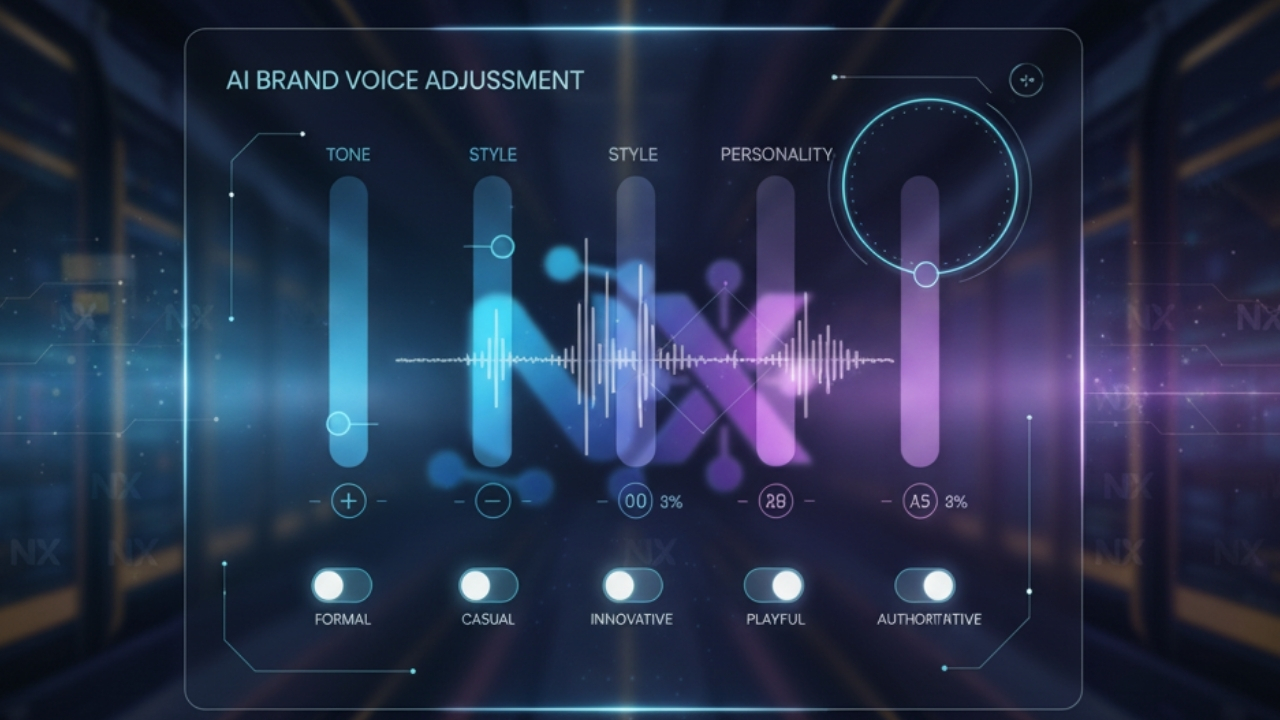
In today’s digital world, artificial intelligence (AI) is no longer a novelty — it’s a necessity. From automated email campaigns to chatbots that respond instantly, AI has become an integral part of how brands communicate. But as these tools become more sophisticated, one challenge continues to stand out: how to make AI sound like you.
Your brand’s voice is the heartbeat of your identity. It reflects your values, personality, and how you connect with your audience. If AI-generated content doesn’t match that voice, it risks sounding robotic, inconsistent, or even off-brand. The good news? With the right strategy, you can train AI to write in your brand’s unique voice — ensuring consistency, authenticity, and trust across every touchpoint.
In this article, we’ll explore what brand voice really means, why it matters, and how to train AI tools to replicate it accurately and effectively.
Understanding Your Brand Voice
Before training AI, you need to know what you’re training it to do.
Your brand voice is more than just tone or word choice — it’s the personality that shines through your communication. It’s how your audience recognizes you, even if your logo or name isn’t visible.
Think of some famous brands:
- Nike speaks with empowerment and energy.
- Apple communicates sophistication and simplicity.
- Innocent Drinks uses humor and friendliness.
Each has a distinct voice that shapes how their content feels.
To define your own, ask yourself:
- How do we want our audience to feel when they read our content?
- What adjectives describe our personality — professional, playful, bold, empathetic?
- What kind of words, phrases, and sentence structures represent us best?
Documenting these elements in a brand voice guide is essential before integrating AI. Without clear direction, even the smartest model won’t know how to “sound like you.”
Why Training AI for Brand Voice Matters
When AI tools write without guidance, they produce generic text. It might be grammatically correct and even engaging, but it won’t sound like your brand.
This inconsistency can:
- Confuse your audience
- Weaken brand recognition
- Reduce trust and loyalty
On the other hand, an AI system trained to write in your voice can:
- Maintain tone across all content — from blogs to tweets to ads
- Speed up production while staying on-brand
- Empower multiple team members to create cohesive messaging
- Scale personalization without losing authenticity
Simply put, a well-trained AI becomes an extension of your creative team — one that speaks fluently in your brand’s language.
Step 1: Create a Comprehensive Brand Voice Guide
Your first task is to codify your brand voice in a way that AI can understand. This document should go beyond vague adjectives like “friendly” or “professional” and include concrete examples.
Here’s what to include:
- Voice Attributes
Choose 3–5 key adjectives that describe your brand’s tone.
For example:
- Confident
- Empathetic
- Conversational
- Inspirational
Then explain what each means in context. For instance:
Confident doesn’t mean arrogant — it means we write with clarity and authority, avoiding hesitation.
- Do’s and Don’ts
Provide examples of language that fits and language that doesn’t.
Example:
✅ “We’re here to help you succeed.”
❌ “Our company strives to deliver assistance.”
- Style Preferences
Clarify sentence structure, formatting, and punctuation rules. Do you use contractions (“we’re,” “can’t”) for a conversational tone? Do you prefer short, punchy sentences or longer, informative ones?
- Emotional Framework
Identify the emotions your brand wants to evoke — excitement, trust, curiosity, or calmness. AI can mimic these patterns when generating content.
Once your guide is complete, you’ll use it as a “training document” for your AI tool.
Step 2: Feed AI with Brand-Aligned Examples
AI learns best from examples. To help it understand your brand voice, you need to provide it with real-world samples of your content — blog posts, emails, ads, or social media captions that perfectly reflect your style.
When possible, choose a mix of formats to show variety:
- Long-form (blogs, newsletters)
- Short-form (tweets, headlines)
- Conversational (customer support replies or community posts)
Then, feed these examples into your AI platform. Some advanced systems like ChatGPT Enterprise, Jasper Brand Voice, or Writer.com allow you to upload sample text directly. Others require you to input content manually.
The AI will analyze your word patterns, tone, sentence length, and rhythm — then use these cues to replicate your style in new content.
Step 3: Develop Custom Prompts for Your Brand
Once your AI has context, the next step is creating brand-specific prompts — instructions that guide how it writes.
A generic prompt like:
“Write a blog post about eco-friendly fashion.”
… might yield decent content.
But a customized prompt like:
“Write a 1,000-word blog post about eco-friendly fashion in a confident yet warm tone. Use simple language, active voice, and encourage readers to take small actions. Avoid jargon.”
… will produce something much closer to your brand’s true voice.
When writing prompts, remember these best practices:
- Specify tone (e.g., empowering, empathetic, humorous)
- Mention audience type (e.g., young professionals, parents, business owners)
- Provide examples of previous content for reference
- Include formatting instructions (headings, bullet points, calls to action)
Over time, you can build a prompt library that ensures anyone on your team — even without writing experience — can generate content aligned with your brand.
Step 4: Fine-Tune and Edit Outputs
Even the best AI won’t nail your brand voice on the first try. Training is an iterative process — you refine as you go.
When reviewing AI-generated drafts, evaluate them against your brand guide:
- Does it sound authentic?
- Are the word choices consistent with our style?
- Does it evoke the right emotion?
- Would our audience recognize this as “us”?
Use feedback loops to improve results:
- Adjust prompts based on what worked or didn’t
- Save strong outputs as “reference examples” for future training
- Correct phrasing errors or stylistic mismatches
The more feedback you give, the better your AI model becomes at writing like your brand. Some tools even allow reinforcement learning — meaning the system learns directly from your edits.
Step 5: Maintain Brand Voice Consistency Across Channels
Once your AI can write in your brand’s voice, the next challenge is consistency.
Your audience interacts with you across many platforms — website, email, ads, social media, chatbots. The goal is to ensure the voice feels the same everywhere.
Here’s how to achieve that:
- Use the same AI configurations and style prompts for all departments.
- Store templates and examples in a shared repository.
- Conduct periodic audits to ensure tone and messaging remain cohesive.
- Update your brand voice guide as your company evolves.
Remember, brand voice is not static — it adapts as your audience and market change. Make sure your AI evolves with it.
Step 6: Combine AI Efficiency with Human Oversight
AI can mimic style, but it doesn’t feel your mission. That’s why the human element remains essential.
Your team’s role should shift from “writers” to “editors and strategists.” Let AI handle the heavy lifting — drafting, outlining, summarizing — while humans refine, personalize, and inject emotion.
This partnership creates a perfect balance:
- AI provides speed and scalability.
- Humans provide depth and authenticity.
In short, AI becomes the assistant, not the author.
Step 7: Measure and Optimize Performance
Finally, assess whether AI-generated content is performing as well as human-written content. Track:
- Engagement metrics (clicks, shares, dwell time)
- Brand perception (comments, sentiment analysis)
- Conversion rates (sales, signups, downloads)
If AI content performs consistently or better — while staying on-brand — you know your training has succeeded. If not, revisit your tone definitions or prompts.
Treat the process as ongoing optimization — just like SEO or social strategy.
Conclusion
Training AI to write in your brand’s voice isn’t about replacing human creativity — it’s about amplifying it. By defining your tone, feeding AI authentic examples, and guiding it with precise prompts, you create a system that writes faster, smarter, and still sounds unmistakably you.
AI doesn’t just copy your words — it learns your essence.
And when combined with human intuition, it becomes a powerful creative ally.
In the end, the goal isn’t for AI to replace your brand voice.
It’s for AI to speak your language — fluently, authentically, and consistently.
About the Author


