

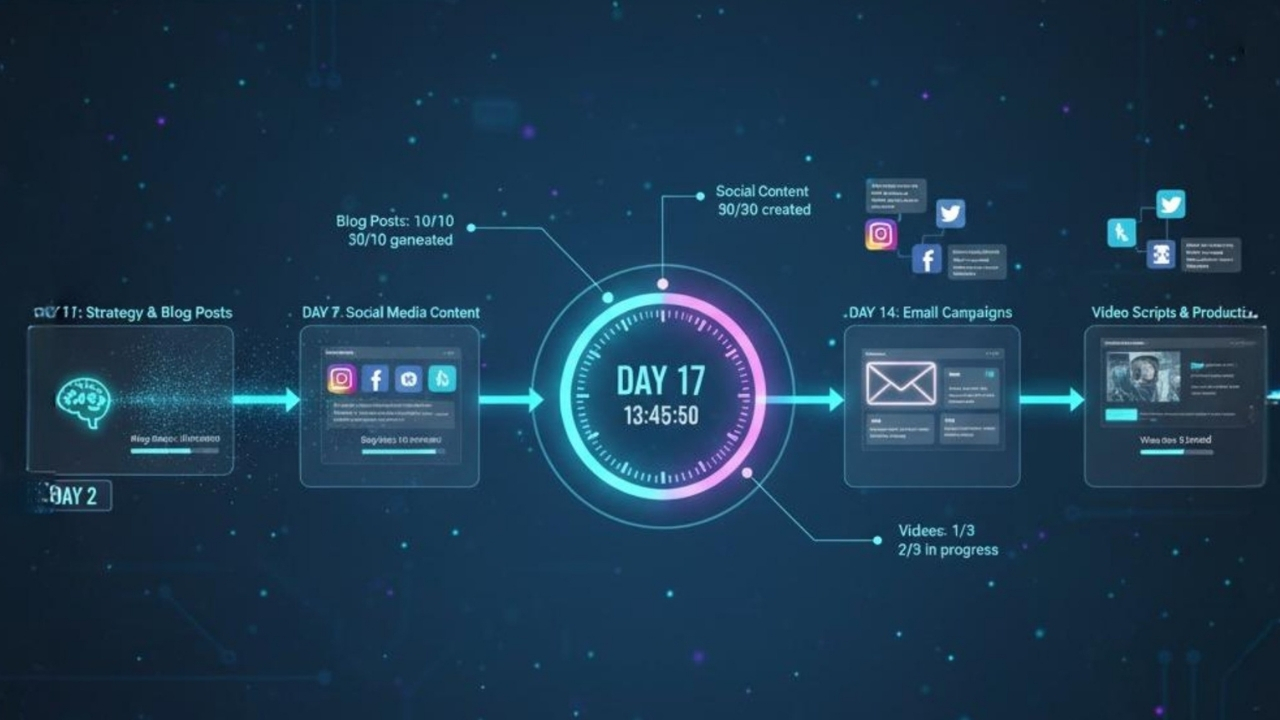
Artificial Intelligence (AI) has become the most talked-about innovation in marketing — and for good reason. It promises to make content creation faster, smarter, and more efficient. But how effective is AI really when it comes to producing consistent, high-quality content that resonates with audiences?
To find out, I ran an experiment: 30 days of content creation powered by AI tools.
For one month, I used a combination of AI writing, image-generation, and scheduling tools to produce daily posts across multiple platforms — including a blog, LinkedIn, and Instagram. The goal was to see whether AI could help maintain consistency, boost engagement, and reduce the time spent on content creation.
Here’s what happened — the results, the surprises, and the valuable lessons learned.
The Setup: Defining the Experiment
Before diving into the tools and results, it was important to set clear expectations.
Goals of the 30-Day Challenge:
- Consistency: Publish at least one piece of content every day for 30 days.
- Efficiency: Reduce the time spent creating each post by at least 50%.
- Quality: Maintain human-level tone, storytelling, and engagement.
- Performance: Measure engagement, reach, and website traffic improvements.
Platforms Used:
- Blog: One long-form article (1–2 times per week).
- LinkedIn: Thought-leadership posts and micro-articles.
- Instagram: Carousel posts and captions.
- Email: One weekly newsletter summarizing the best insights.
AI Tools Used:
- ChatGPT (OpenAI): For ideation, drafting, and editing posts.
- Jasper AI: For maintaining consistent brand voice and tone.
- Canva Magic Write: For visual content and captions.
- Pictory: For turning blog snippets into short videos.
- Hootsuite AI Scheduler: For timing and automation.
The challenge started with a library of past blog posts and notes — but most content was generated or heavily rewritten by AI throughout the month.
Week 1: Finding the Flow
The first week was all about experimenting and understanding the tools.
AI immediately proved its value in content ideation. I used prompts like:
“Generate 10 social media post ideas for small business marketing using AI.”
Within seconds, I had a full list of relevant topics — enough for two weeks’ worth of content. This alone saved hours of brainstorming time.
For writing, ChatGPT handled blog drafts impressively. It produced well-structured outlines and coherent paragraphs that only needed about 20–30 minutes of human editing.
However, I quickly realized that AI lacks personality by default. Early drafts sounded polished but generic — the kind of content that could come from anyone.
Lesson 1: AI gives you structure, but you must add your story.
Readers respond to authenticity. The key is layering personal experience, real examples, and insights into AI-generated text. Once I began doing that, engagement immediately improved.
Week 2: Speed Meets Strategy
By week two, I found my rhythm. I’d start each morning by prompting ChatGPT or Jasper to draft 2–3 pieces of content. Then, I’d refine tone, fact-check, and schedule posts for the week.
Time-wise, the results were astounding.
- Before AI: ~3–4 hours to write a blog post
- With AI: ~1 hour total, including edits
- Before AI: ~30 minutes per social caption
- With AI: ~5–10 minutes
AI helped me stay ahead of schedule — I had a full content calendar ready by Day 14.
But there was a new challenge: quality control.
AI sometimes reused phrases or overused certain adjectives (“innovative,” “game-changing,” “seamless”) — small details that made posts feel repetitive.
Lesson 2: Always human-edit for tone, originality, and rhythm.
AI drafts are a starting point. The final polish — making language more vivid, conversational, or emotionally engaging — still requires a human touch.
Week 3: Experimenting with Formats
By week three, I wanted to push the boundaries. Could AI help me repurpose content effectively?
Here’s what I tried:
- Turned a blog post into a LinkedIn carousel using Canva Magic Write.
- Transformed 3 blog paragraphs into a 90-second video script using Pictory.
- Used AI to summarize key points into email newsletter copy.
The outcome was impressive — especially for multi-format repurposing. The AI tools understood tone and adjusted the format automatically.
For example, Pictory extracted concise, attention-grabbing quotes from longer articles and overlaid them on video templates. It required minimal tweaking and made repurposing far easier than doing it manually.
Lesson 3: AI shines in content transformation.
If you have long-form content like blogs, podcasts, or webinars, AI can instantly spin them into shorter, platform-ready pieces — saving massive amounts of time.
Week 4: Measuring Results
By the final week, I had posted 30 consecutive days of content across platforms. The numbers spoke volumes.
Engagement and Traffic:
- Blog traffic: ↑ 42% compared to the previous month.
- LinkedIn engagement: ↑ 56% (mostly from posts with personal commentary added).
- Instagram reach: ↑ 35% (AI-crafted captions with emojis and CTAs performed best).
- Email open rate: ↑ 18%, likely due to consistent delivery and fresh topics.
The biggest improvement wasn’t just in numbers — it was in workflow. What once felt like a chore became a smooth, structured process.
Yet, I noticed that not all AI-generated posts performed equally.
The best-performing content always had three things in common:
- A human story or opinion at the center.
- A clear visual or hook in the first line.
- A conversational tone — short sentences, real-world examples, and emotional appeal.
Posts that were fully AI-written (with minimal editing) looked polished but lacked soul. They got likes, but fewer comments or shares.
Lesson 4: AI can generate attention, but humans generate connection.
Engagement thrives on relatability. AI may write perfect grammar, but only humans can inject authenticity.
Unexpected Challenges
While the experiment was largely successful, a few challenges stood out:
- Overdependence on AI: It’s tempting to let AI do everything, but that can dull your creative instincts over time.
- Fact-checking gaps: AI occasionally generated outdated or inaccurate information. Verification was crucial.
- Platform nuance: AI sometimes misunderstood the cultural tone of different platforms (e.g., overly formal captions on Instagram).
These challenges reinforced that AI works best as a partner, not a replacement.
Key Takeaways from 30 Days of AI-Driven Content
After a full month of using AI tools daily, here’s what I learned — the good, the bad, and the game-changing:
- AI multiplies output, not creativity.
AI speeds up production but doesn’t replace creative vision. The best content still comes from blending machine precision with human insight.
- Workflow optimization is the real benefit.
Automation tools made scheduling, repurposing, and consistency far easier. Less time was spent switching between platforms, freeing hours for strategy.
- Voice and tone matter more than ever.
With so many AI-generated posts online, your unique brand voice becomes your competitive edge. Human editing ensures your content stands out.
- Data-driven iteration fuels improvement.
AI tools can track engagement metrics, helping refine content strategies based on what resonates most.
- Authenticity wins every time.
Even in a world filled with AI content, human emotion and storytelling remain irreplaceable.
Final Results: Was It Worth It?
Absolutely — but with caveats.
Over 30 days, I produced:
- 8 blog posts
- 15 LinkedIn updates
- 20 Instagram captions
- 4 newsletters
… all in less time than it used to take to produce half that.
The combination of AI speed and human storytelling proved incredibly powerful. It boosted efficiency, improved consistency, and led to higher engagement — without compromising quality.
However, success required intentionality. The key was not letting AI lead, but using it as a co-creator — a digital assistant that amplifies your creativity instead of replacing it.
Conclusion
The 30-day AI content challenge proved that AI isn’t the enemy of creativity — it’s an accelerator of it.
It won’t write your brand story for you, but it will give you the structure, speed, and insights you need to tell it more effectively.
AI can take care of the heavy lifting — research, drafting, repurposing — while you focus on what matters most: your audience, your message, and your voice.
In short, the future of content isn’t human or AI.
It’s human and AI — working together to create smarter, faster, and more meaningful stories.
About the Author


