

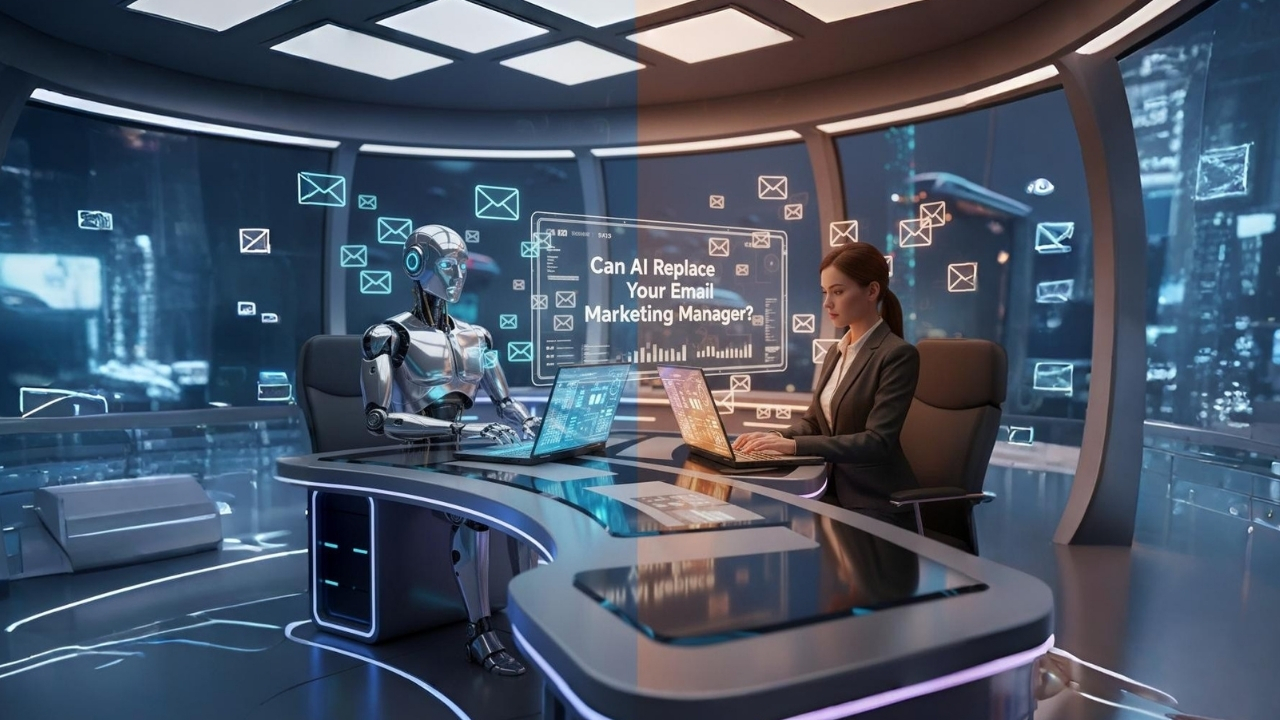
Artificial Intelligence (AI) has rapidly evolved from a futuristic concept into a practical business tool. It’s transforming how we communicate, automate, and market products — and email marketing is no exception.
As AI becomes more powerful, many business leaders and marketers are asking an uncomfortable question:
“Can AI replace my email marketing manager?”
The short answer is — not yet.
But to understand why, we need to dive deeper into what AI can (and cannot) do for email marketing. In this article, we’ll explore how AI is changing the email landscape, where it excels, where it falls short, and why the most effective email strategies still need the human touch.
The Rise of AI in Email Marketing
Email marketing remains one of the most cost-effective digital marketing channels, generating an average $36 for every $1 spent. But managing it effectively requires creativity, timing, and precision. From writing copy to analyzing data, it’s a complex job.
AI has stepped in to simplify that complexity. Over the last few years, AI-powered tools have transformed how brands:
- Write email copy and subject lines
- Segment audiences
- Personalize content
- Optimize send times
- Analyze campaign performance
These tools promise to do what used to take hours in a matter of seconds — with improved accuracy and scalability.
So it’s understandable that some businesses wonder if they still need a full-time email marketing manager at all.
What an Email Marketing Manager Actually Does
Before we can answer whether AI can replace this role, let’s break down what an email marketing manager really does.
Their responsibilities go far beyond clicking “send.” A great email marketing manager:
- Develops strategy — decides what messages to send, when, and to whom.
- Crafts content — writes compelling copy that reflects brand tone.
- Designs campaigns — aligns visuals and layout for maximum engagement.
- Manages lists and segments — ensures accuracy, hygiene, and compliance.
- Analyzes results — interprets data to improve future campaigns.
- Coordinates with teams — works with sales, design, and customer service for consistent communication.
Now, let’s see how AI fits into this picture.
Where AI Excels in Email Marketing
AI isn’t here to replace humans — it’s here to amplify their productivity. When used correctly, AI can take care of the repetitive, data-heavy tasks that often slow marketers down.
Here’s where AI truly shines:
- Automated Content Generation
AI tools like ChatGPT, Jasper, and Copy.ai can write persuasive subject lines, product descriptions, and even entire email sequences. They analyze tone, style, and audience preferences to produce on-brand content in seconds.
This capability saves marketers hours each week and helps teams scale content without sacrificing quality.
- Predictive Send-Time Optimization
AI algorithms can analyze user behavior to determine when each subscriber is most likely to open and engage with an email. Instead of guessing, AI ensures every message lands in the inbox at the perfect time.
Tools like Seventh Sense and Sendinblue use these insights to increase open and click-through rates significantly.
- Audience Segmentation
AI can process massive datasets to identify subtle patterns in customer behavior. It can automatically group subscribers into micro-segments — such as “frequent buyers,” “inactive users,” or “price-sensitive shoppers.”
This means every recipient receives a tailored message that feels personal, not generic.
- Subject Line Optimization
AI tools like Phrasee analyze millions of subject lines to predict which words and emotional triggers will get the most opens. By learning from performance data, they can generate high-performing subject lines faster and more accurately than a human writing from scratch.
- Performance Analytics
AI can crunch campaign data in real time, showing which strategies deliver the best ROI. It can track open rates, conversions, bounce rates, and customer journeys — and even suggest improvements automatically.
Where a human might take hours to create a report, AI does it in seconds with visual dashboards and actionable insights.
Where AI Falls Short
While AI is powerful, it isn’t perfect — especially when it comes to emotional intelligence, strategic thinking, and creativity.
Here’s where humans still outperform machines:
- Brand Voice and Emotional Nuance
AI is great at imitating writing styles, but it struggles with subtlety and context. An email marketing manager understands tone, humor, and empathy — elements that define a brand’s unique personality.
For example, an AI might write a technically correct email, but it may sound too robotic or fail to capture the emotional connection that builds loyalty.
- Creative Campaign Strategy
AI can execute tactics, but it doesn’t create strategy. It can’t brainstorm a new product launch concept, decide how to align campaigns with seasonal trends, or integrate storytelling with brand values.
These high-level decisions require human creativity and critical thinking — areas where machines still lag behind.
- Relationship Building
Successful email marketing isn’t just about numbers — it’s about trust. Humans know how to read social cues, respond with empathy, and build relationships over time. AI can automate outreach, but it can’t genuinely connect.
A human marketer understands when a softer touch or a personal follow-up is needed — AI doesn’t.
- Data Ethics and Sensitivity
AI systems rely on massive amounts of user data. Without human oversight, there’s a risk of violating privacy norms or crossing ethical boundaries. A human manager ensures compliance with laws like GDPR and maintains transparency with customers.
- Adaptation and Context
AI thrives on patterns. But when something unexpected happens — like a global event, a cultural shift, or a PR crisis — AI can’t adapt quickly. Humans can think critically, pivot strategies, and handle nuance when data alone isn’t enough.
The Ideal Approach: Collaboration, Not Replacement
Rather than replacing your email marketing manager, think of AI as their co-pilot.
AI handles automation, optimization, and analytics — the technical side of marketing — while your manager focuses on creativity, storytelling, and emotional connection.
Here’s how that collaboration looks in practice:
- AI analyzes engagement data → Human interprets what it means for brand growth.
- AI drafts an email → Human refines tone, emotion, and structure.
- AI identifies patterns → Human builds long-term strategy.
Together, they create campaigns that are both efficient and authentic — blending data-driven precision with human empathy.
Real-World Example: The AI-Human Hybrid Model
Imagine a SaaS company running a product announcement campaign.
- The AI system segments the email list based on product usage.
- It writes three subject line variations and predicts open rates.
- It schedules sends based on each subscriber’s historical behavior.
Then, the human manager steps in:
- Adjusts the copy to match the brand voice.
- Adds emotional appeal and storytelling elements.
- Reviews the sequence to ensure ethical, customer-focused messaging.
The result? A campaign that feels personalized and human — but built at machine speed.
Will AI Replace Email Marketing Managers?
AI will certainly redefine the role, but not eliminate it.
In the next few years, email marketing managers won’t spend their time writing every word or analyzing every metric. Instead, they’ll become AI strategists — guiding automation tools, setting creative direction, and ensuring campaigns align with human values.
AI will handle the how, but humans will still decide the why.
So, while AI can automate tasks, improve productivity, and uncover insights, it can’t replicate human intuition, ethics, and creativity — the traits that make marketing truly effective.
The Future: Human Intelligence Enhanced by AI
The future of email marketing isn’t humans vs. AI — it’s humans with AI.
As automation tools evolve, email marketers will focus more on strategy, personalization, and brand storytelling. AI will continue to enhance speed, accuracy, and data insights — freeing creative professionals to do what they do best: build relationships that matter.
AI might write your next subject line, but it won’t understand your customers’ emotions — at least, not yet.
The smartest businesses will use both: letting machines handle the numbers while humans craft the narrative.
Conclusion
So, can AI replace your email marketing manager?
Not quite.
AI can automate tasks, predict engagement, and optimize performance — but it can’t replace the creativity, empathy, and strategic vision of a human marketer.
The real power lies in collaboration: letting AI do the heavy lifting while humans focus on connection, context, and creativity.
When both work together, your email marketing becomes faster, smarter, and far more effective — proving that the future of marketing isn’t about replacement, but enhancement.
About the Author


